
Not sure what to say when you sit down to pray? These three free Christian guided meditation scripts give you words to begin. Choose one for a worried moment, bedtime, or the start of your day. Read slowly and pause wherever you need.
To print a script: copy the one you want into a document and print it, or use your browser’s Print option. The free scripts below are web text, not a separate PDF download.
What Scripture Says About Guided Prayer and Meditation
These scripts use Bible passages as a starting point for prayer. Psalm 119:15 describes meditating on God’s precepts; Philippians 4:6–7 invites believers to bring their requests to God. Read the surrounding passage in your Bible when you have time.
You do not need to force a calm feeling or find a special message. Read, notice a phrase, and respond honestly in prayer. The guided wording is an original reflection, not additional Scripture. Continuing to feel worried does not mean you have failed at prayer.
How to Use These Scripts
Before we get to the scripts themselves, a few practical notes:
- Read slowly. These aren’t meant to be rushed. Pause at the ellipses. Let each sentence settle before moving on.
- Read aloud or silently. Both work. Some people find reading aloud helps keep their attention from drifting; others prefer the inner quiet of silent reading. Try both and see what works.
- Print them. Keep a copy in your Bible, on your nightstand, or inside a journal so it is easy to return to.
- Use them with others. Read a script to your spouse before bed. Use the morning script as a family devotional. These weren’t designed for solo use only.
- Come back to them. You may read the same script many times. That’s not laziness — it’s how deep formation works. The same Scripture can land differently every time, because you are different every time.
Script 1: Christian Guided Meditation for Anxiety
Based on Philippians 4:6-7 and Isaiah 26:3. Best used when worry feels overwhelming, before a stressful event, or anytime your mind won’t stop racing. Allow 8-12 minutes.
Find a comfortable position — seated or lying down. Let your hands rest open in your lap, or at your sides. Close your eyes if that’s comfortable, or let your gaze soften toward the floor.
Take a slow breath in… and let it out gently. Again — breathe in slowly… and release. One more time: a deep breath in… and a long, steady breath out. Let your shoulders drop. Let your jaw unclench. You don’t have to hold anything right now.
Bring to mind what you’re carrying today. Don’t push it away — let it surface. The worry about money, or health, or a relationship, or something you said, or something you can’t control. Name it quietly in your mind. It’s real. It’s heavy. And you don’t have to pretend it isn’t.
Now hear these words from Philippians 4:6-7: “Do not be anxious about anything, but in every situation, by prayer and petition, with thanksgiving, present your requests to God. And the peace of God, which transcends all understanding, will guard your hearts and your minds in Christ Jesus.”
Notice the word “guard.” God’s peace is not passive — it stands like a sentinel at the gate of your heart and mind. It’s not you working harder to calm down. It’s His peace taking up its post.
Silently, in your own words, name what you’re worried about before God right now. You can be direct. You can be honest. He is not surprised, and He is not disappointed. Simply say: “Lord, I bring You this: ___________.” Name it as plainly as you can. Then say: “I release this into Your hands.”
Now breathe: slowly in, “You keep me in perfect peace.” Slowly out, “…because my mind is stayed on You.” Again. In: “You keep me in perfect peace.” Out: “…because I trust in You.”
Sit with that truth. Let it settle into the places the worry has been living. Not by force — by invitation. You are not alone in this. You are not carrying this alone. The One who spoke the world into existence has your situation held in His hands. You can open yours.
Rest here for as long as you need. When you’re ready, take a slow breath, and gently return.
A NEXT STEP FROM UNUSUALMONK
Want a page to return to tomorrow?
If written guidance helps you begin, 21 Days to Biblical Peace gives you a 21-day sequence of Scripture, written meditations, reflection space and evening prayers. Day 1, “Casting Your Burdens,” is a place to start.
The images below are the actual Day 1 pages from the paid journal. Open the preview to read them full size before you decide.
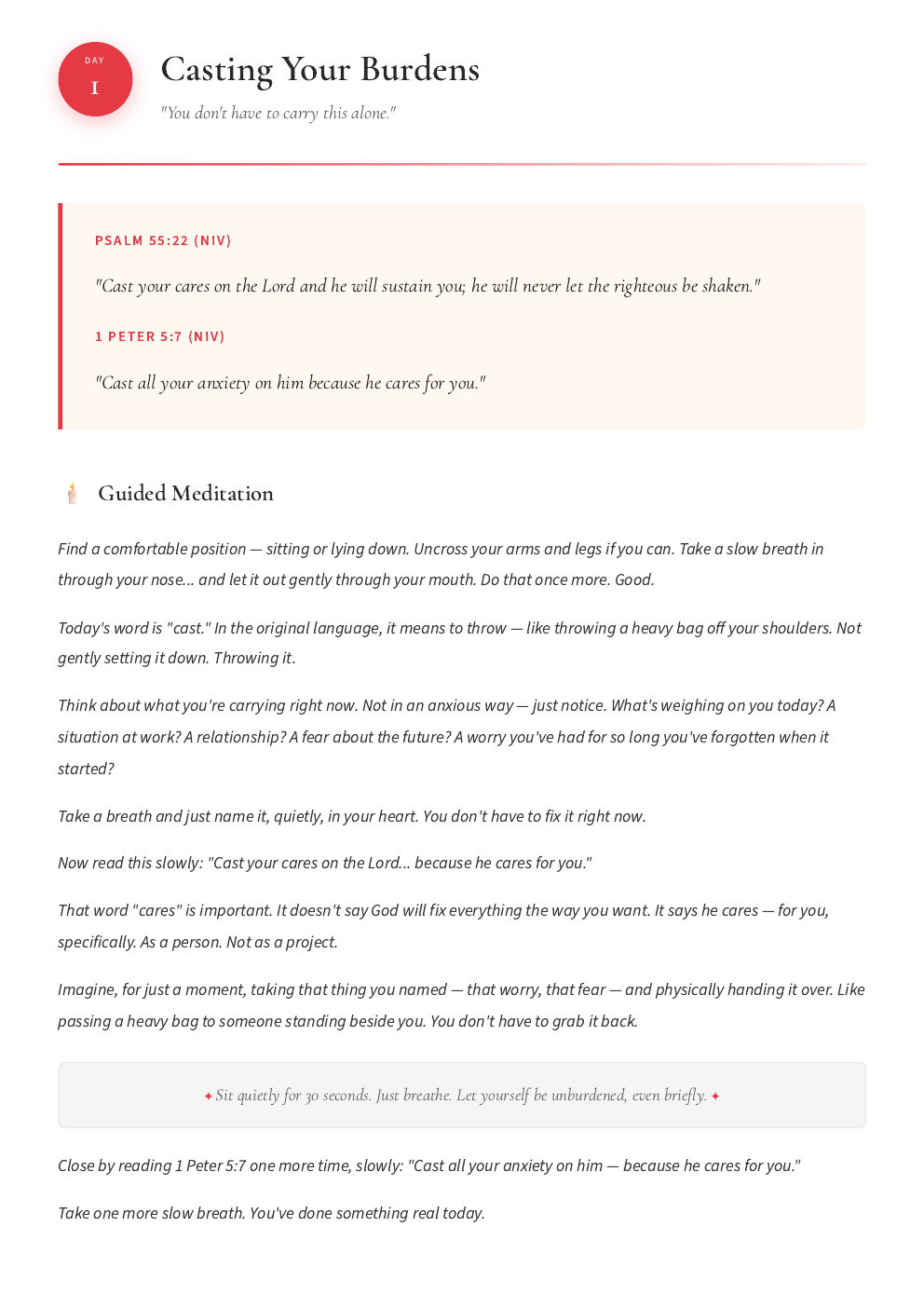
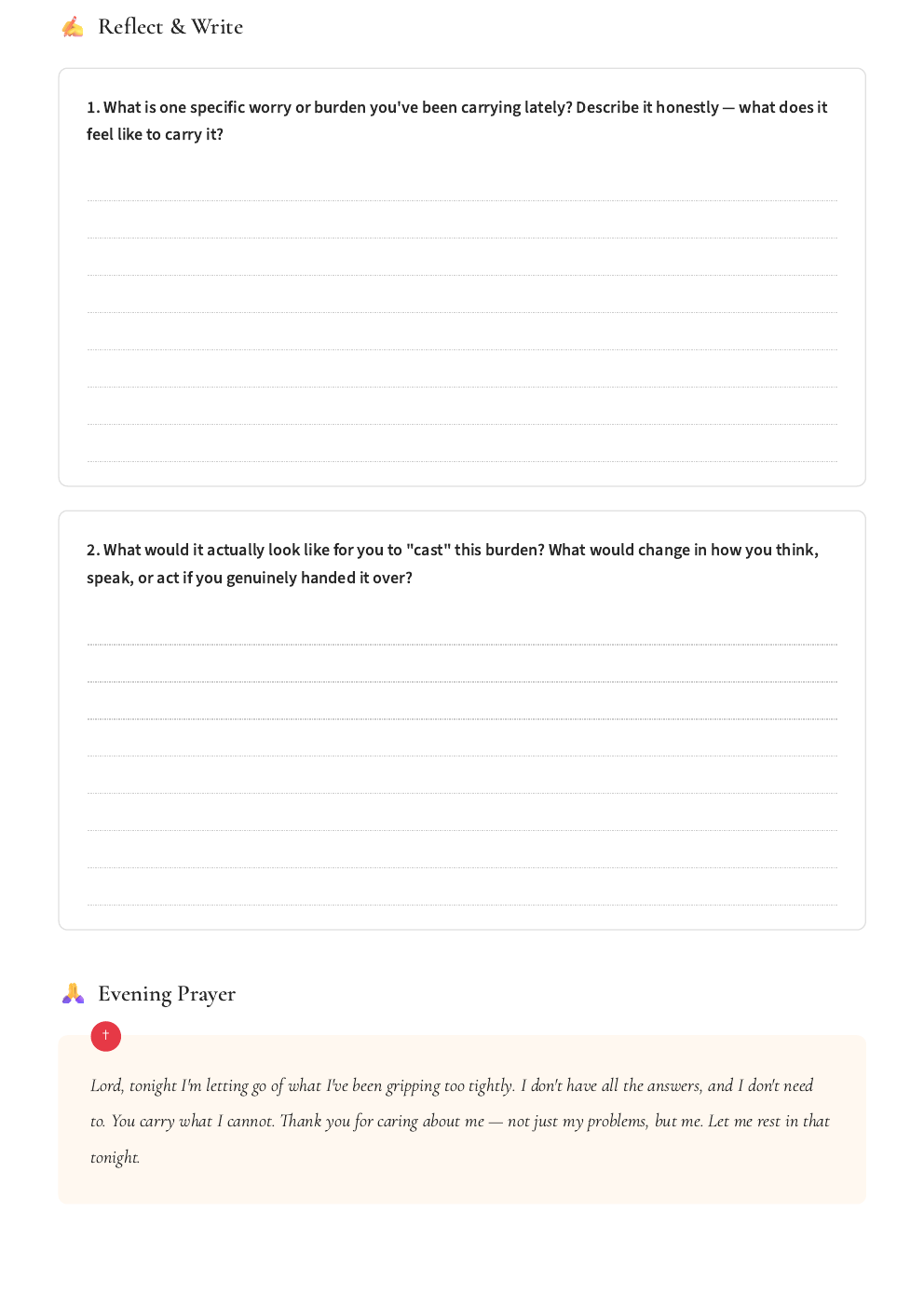
Preview the actual Day 1 pages →
The full journal is a paid digital A4 PDF. Print it or write with a PDF annotation app. It does not include audio or a shipped book. The free scripts in this article remain available above and below.
Script 2: Christian Guided Meditation for Sleep
Based on Psalm 91 and Psalm 4:8. Best used at bedtime, lying down in the dark. Allow 10-15 minutes. You do not need to finish the script or fall asleep for the practice to count.
You are lying down now. Let your body be heavy against whatever is supporting you. You don’t need to hold yourself up. Let the bed hold you. Let the night be quiet around you.
Take a breath in through your nose… and let it out through your mouth. Slowly. Again: in… and out. One more: in… hold for just a moment… and release. With that breath, let the day begin to leave you. It is finished. Whatever you didn’t finish today — it can wait for tomorrow. This moment is for rest.
Hear these words from Psalm 4:8: “In peace I will lie down and sleep, for you alone, Lord, make me dwell in safety.”
Say that with me, quietly in your heart: In peace I will lie down and sleep… for You alone, Lord, make me dwell in safety. Not my plans. Not my vigilance. Not my anxiety working through the night. You alone, Lord. That is where my safety comes from.
Now hear Psalm 91:4: “He will cover you with his feathers, and under his wings you will find refuge; his faithfulness will be your shield and rampart.”
Picture that covering. Not metaphorically — really picture it. The God who holds all things, covering you right now, in this room, in this night. His presence is not distant. It is here. The darkness does not frighten Him. He does not sleep, but you can — because He is watching.
If your mind goes to something you’re worried about, don’t fight it. Just name it gently: “Lord, I give You this worry about _________. I don’t have to solve it tonight. You are awake. I can rest.” And then return to these words: In peace I will lie down and sleep.
Let your breathing become slow and natural. You are safe. You are covered. You are not alone in the dark. The Lord of all things is here, and His eye is on you through this night.
Rest now. Sleep is a gift. Receive it. In peace I will lie down and sleep… for You alone, Lord, make me dwell in safety.
Want to go deeper? The Psalm 23 sleep meditation is a full 20-minute guided experience for the nights when rest feels impossible.
Script 3: Christian Guided Meditation for Morning Peace
Based on Lamentations 3:22-23 and Psalm 5:3. Best used first thing in the morning, before checking your phone or beginning your day. Allow 5-10 minutes.
Before this day makes any demands on you — before the notifications, the to-do list, the faces that need things from you — take a moment to arrive. You are here. This morning is new. Let that be real to you before anything else is real.
Breathe in slowly… and out. In… and out. Let the weight of yesterday’s unfinished business stay where it is, just for now. This moment is not for carrying. It’s for receiving.
Hear these words from Lamentations 3:22-23: “Because of the Lord’s great love we are not consumed, for his compassions never fail. They are new every morning; great is your faithfulness.”
New every morning. Not recycled mercy — new. The mercy available to you this morning has not been depleted by everything you brought to yesterday. It is not running low. It is fresh, full, and waiting for you right now. You have not used it up. You cannot.
Say quietly: “Lord, I receive Your mercy for this day. Yesterday is finished. This morning is new. I begin again.”
Now bring yourself — the real you — into this moment with God. Not the composed version. The actual version: tired, uncertain, hopeful, worried, grateful, or some mixture of all of it. God knows already. You don’t have to present anything. Just come as you are.
Ask one simple question: “Lord, what do You want me to know as I begin this day?” Then be quiet. Not straining for an answer — just open. Sometimes a verse comes. Sometimes a word. Sometimes nothing words can capture, only a quiet sense of being held. All of it is enough.
Carry this into your morning: “His compassions are new every morning. I am not behind. I am not depleted. I begin today held by the one who holds all things.”
For more on building a full morning rhythm, the Christian morning meditation guide walks through five practical ways to start your day with God before the chaos begins.
Additional Verses for Your Practice
Psalm 46:10 (NIV): “Be still, and know that I am God.” — Use this as an anchor breath prayer: breathing in, “Be still.”; breathing out, “…and know that You are God.” It works in any moment, any location, any level of chaos. Reflection: What would it mean to truly be still — not just physically, but in your heart — for two minutes today?
Romans 8:26 (NIV): “The Spirit helps us in our weakness. We do not know what we ought to pray for, but the Spirit himself intercedes for us through wordless groans.” — On the mornings when you can’t find words, this verse is your permission to simply show up without language. The Spirit prays in you when you don’t know how. Reflection: What would it feel like to come to prayer today with no agenda — just presence?
Psalm 62:1 (ESV): “For God alone, O my soul, wait in silence, for my hope is from him.” — A verse for the moments when silence feels uncomfortable. Silence before God is not emptiness; it is trust. Reflection: Where in your life are you filling silence with noise because waiting feels too vulnerable?
How to Create Your Own Christian Guided Meditation Script
Once you’ve used these three scripts a few times, you might want to write your own. Here’s a simple structure you can follow:
- Choose a Scripture passage. One verse or a short passage. Not a whole chapter — something you can sit with.
- Read it three times slowly. Notice a word or phrase that catches your attention, and consider it in the context of the passage.
- Write a short opening. Acknowledge where you are — tired, anxious, grateful, confused. Honesty first.
- Insert the Scripture. Read it again, this time as a prayer spoken directly to you by God.
- Add a breath prayer. A short phrase to breathe in and out with. Example: In — “The Lord is my shepherd.” Out — “I shall not want.”
- Close with surrender. A sentence that releases the outcome to God. “I trust You with this day. I trust You with this night.”
Keep it under 300 words for your first attempt. You can always add more later. If you want to understand whether this kind of practice is biblically grounded, Is Meditation a Sin for Christians? covers the theology in detail.
Frequently Asked Questions
Are Christian guided meditation scripts biblically sound?
Yes — when they’re anchored in Scripture and directed toward the God of the Bible, guided meditation is entirely consistent with orthodox Christian practice. The Psalms are full of examples of deliberate, structured reflection on God’s Word: “I meditate on your precepts and consider your ways” (Psalm 119:15, NIV). The early church fathers practiced what they called “rumination” — slowly chewing on Scripture the way David described. If a script leads you deeper into God’s Word, deeper in prayer, and deeper in trust, it is a faithful tool.
How long should a Christian guided meditation last?
There is no required length. The suggested times above allow for slow reading and pauses. Start with one short section if you only have a few minutes, and return when you can. You do not need to finish every line.
Can I use these scripts with my children or as a family?
You can read a short section together and use simpler wording for younger children. Let each person choose whether to join in or keep their eyes open. Read at a comfortable pace, without expecting anyone to feel a particular way.
What’s the difference between Christian guided meditation and secular meditation?
In these Christian scripts, the focus is Scripture and prayer to God. Other forms of meditation use different practices and aims. These scripts give you a way to reflect on a Bible passage and respond in your own words.
What if my mind keeps wandering during the script?
That’s completely normal — and it doesn’t mean you’re failing. In fact, noticing that your mind has wandered is itself a moment of awareness. When it happens, don’t get frustrated. Gently return to the last phrase you read. Some people find it helps to read the script aloud rather than silently, or to trace each word with a finger as they go. Over time, your ability to stay present will grow — not because you’re trying harder, but because you’re training your heart to return to God, which is the whole point.
A Closing Word and Short Prayer
There is nothing complicated about any of this. You don’t need training, talent, or a particularly composed inner life. You need a few minutes, a willingness to be honest before God, and something to hold onto when your own words fail. That’s what these scripts are for.
Come back to them when the anxiety gets loud again. Come back when sleep won’t come. Come back on the mornings when you feel like you’re starting the day already behind. These pages will still be here — and so will He.
Lord, thank You that peace is not something I have to manufacture — it’s something You give. Thank You that Your Word is not just information but food, medicine, and light for the actual life I’m living right now. Help me come back to these pages on the hard days. Help me bring my real self — not the polished version — before You. And let something of Your presence settle in me today that no amount of worry or noise can fully reach. Amen.
Related: If you are struggling with waiting on God while practicing these techniques, you might find peace in these Bible verses about patience.
Continue from a guided script
These scripts can help you begin one focused session. If you would like a simple way to continue the practice with Scripture, written prayer and reflection space, see the journal sample before deciding whether the full journal fits your practice.