
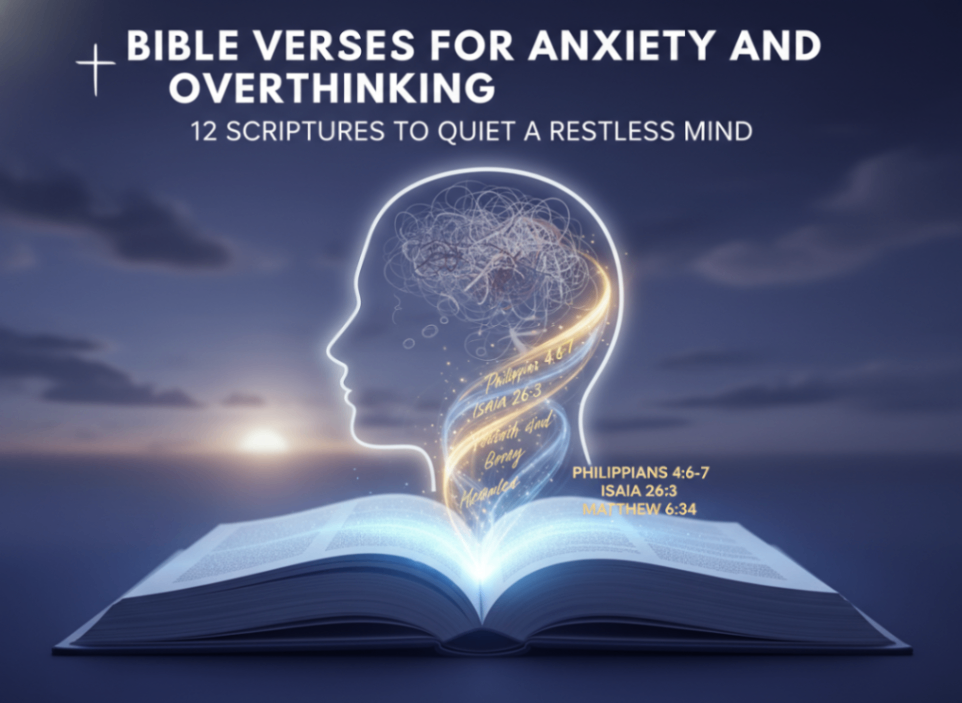
Your mind is still going. It was going when you closed your laptop last night, when you finally lay down to sleep, and now it’s already spinning before you’ve even had your first cup of coffee. The “what ifs” don’t wait for an invitation — they show up uninvited, pile on top of each other, and by midday you’re exhausted from a battle happening entirely inside your own head.
If that’s where you are right now, you’re not broken. You’re not failing at faith. You’re human — and you’re in good company. The Bible doesn’t skip over anxiety and overthinking. It meets you right in the middle of it.
These 12 Bible verses for anxiety and overthinking aren’t meant to be quick fixes you paste on a sticky note and forget. They’re living words — the kind that, when you sit with them, begin to shift something deep inside. Let them work on you slowly, like light coming in through a window you didn’t realize you’d closed.
What the Bible Actually Says About Overthinking
Before we get to the verses, it’s worth noting something: Scripture doesn’t tell you to stop thinking. God gave you a mind, and He wants you to use it. The issue isn’t thought — it’s where your thoughts are anchored.
Overthinking happens when your mind loops on fear, uncertainty, and worst-case scenarios without any resting place. The biblical answer isn’t an empty mind — it’s a redirected one. As Paul wrote:
“Finally, brothers and sisters, whatever is true, whatever is noble, whatever is right, whatever is pure, whatever is lovely, whatever is admirable — if anything is excellent or praiseworthy — think about such things.” (Philippians 4:8, NIV)
That’s not a command to stop thinking. It’s an invitation to think differently — to redirect your mental energy from anxious loops to anchored truth. This is the heart of Christian meditation for anxiety: filling the mind with what is true instead of what is feared.
12 Bible Verses for Anxiety and Overthinking
1. Philippians 4:6-7 — The Blueprint for Trading Anxiety for Peace
“Do not be anxious about anything, but in every situation, by prayer and petition, with thanksgiving, present your requests to God. And the peace of God, which transcends all understanding, will guard your hearts and your minds in Christ Jesus.” (Philippians 4:6-7, NIV)
This is perhaps the most direct biblical address of anxiety in the New Testament. Notice what Paul is describing: a transaction. You bring your anxiety to God in prayer and thanksgiving — and in return, a peace that defies human logic stands guard over your mind. Not a peace you manufacture. A peace that guards you.
2. Isaiah 26:3 — Peace for the Fixed Mind
“You will keep in perfect peace those whose minds are steadfast, because they trust in you.” (Isaiah 26:3, NIV)
The Hebrew phrase for “perfect peace” here is shalom shalom — doubled for emphasis. Complete, whole, nothing missing. The condition? A steadfast mind. Not a perfect mind, not a mind that never wanders — but one that keeps returning to God when it drifts. Every time you redirect your thoughts back to Him, you are living this verse.
3. Matthew 6:34 — Jesus on Worrying About Tomorrow
“Therefore do not worry about tomorrow, for tomorrow will worry about itself. Each day has enough trouble of its own.” (Matthew 6:34, NIV)
Overthinking is almost always about the future. We replay what might happen, catastrophize outcomes that haven’t arrived, and exhaust ourselves fighting battles that may never come. Jesus gently points us back to today — the only moment we actually inhabit. You don’t have to solve tomorrow right now.
4. 1 Peter 5:7 — Permission to Let Go
“Cast all your anxiety on him because he cares for you.” (1 Peter 5:7, NIV)
The word “cast” is active — it implies an intentional throwing, like a fisherman casting a net. You don’t gently place your anxiety on God hoping He notices. You throw it. And the reason isn’t duty or theology — it’s that He genuinely, personally cares about what is troubling you right now.
5. Psalm 94:19 — When Anxiety Is Overwhelming
“When anxiety was great within me, your consolation brought me joy.” (Psalm 94:19, NIV)
What’s beautiful here is the Psalmist’s honesty: anxiety was great within me. Not a small tremor. Great. Overwhelming. And yet God’s consolation — His comfort — was greater still. This verse gives you permission to acknowledge how hard it really is while simultaneously pointing to a God whose comfort outpaces your struggle.
6. Romans 8:28 — When You Can’t See How It Will Work Out
“And we know that in all things God works for the good of those who love him, who have been called according to his purpose.” (Romans 8:28, NIV)
Much of our overthinking is a desperate attempt to control outcomes we can’t see. This verse doesn’t promise every outcome will feel good — it promises that God is actively working all things toward your good. You don’t have to figure out how. That’s His job. Your job is to trust.
7. Proverbs 3:5-6 — Trading Your Understanding for His
“Trust in the LORD with all your heart and lean not on your own understanding; in all your ways submit to him, and he will make your paths straight.” (Proverbs 3:5-6, NIV)
Overthinking often happens when we lean too heavily on our own understanding — analyzing, predicting, planning for every contingency. This verse doesn’t dismiss wisdom, but it gently invites us to loosen our grip on the need to figure everything out ourselves. Lean on Him, not the loop.
8. 2 Timothy 1:7 — You Were Not Made for This Fear
“For the Spirit God gave us does not make us timid, but gives us power, love and self-discipline.” (2 Timothy 1:7, NIV)
Fear and anxiety can feel like your natural state — like this is just who you are. This verse corrects that narrative. The spirit of fear didn’t come from God. What God gave you is power, love, and a sound mind. Anxiety is not your identity. It’s not your destiny either.
9. John 14:27 — A Peace the World Can’t Offer
“Peace I leave with you; my peace I give you. I do not give to you as the world gives. Do not let your hearts be troubled and do not be afraid.” (John 14:27, NIV)
The world’s version of peace is the absence of problems. Jesus offers something different — peace in the midst of unresolved situations. Notice He doesn’t say “I’ll remove your trouble.” He says “Do not let your hearts be troubled.” There’s an invitation here to receive a peace that doesn’t depend on circumstances changing first.
10. Psalm 46:10 — The Power of Being Still
“He says, ‘Be still, and know that I am God.’” (Psalm 46:10, NIV)
Sometimes the most spiritually powerful thing you can do with an anxious, overthinking mind is nothing. Stop. Be still. Not to empty yourself — but to remember that God is God and you are not. The weight of the universe was never on your shoulders to carry. You don’t have to think your way out of this.
11. Isaiah 41:10 — You Are Not Alone in This
“So do not fear, for I am with you; do not be dismayed, for I am your God. I will strengthen you and help you; I will uphold you with my righteous right hand.” (Isaiah 41:10, NIV)
Anxiety is isolating. It makes you feel like you’re facing the worst-case scenario completely alone. But here God speaks directly: I am with you. I will strengthen you. I will uphold you. You are not abandoned in the middle of this spiraling mind. He is right here.
12. Psalm 23:1-3 — The Shepherd Who Restores
“The LORD is my shepherd, I lack nothing. He makes me lie down in green pastures, he leads me beside quiet waters, he refreshes my soul.” (Psalm 23:1-3, NIV)
When your mind is running on empty from the exhaustion of overthinking, this ancient psalm is a place to rest. A shepherd doesn’t drive the sheep — he leads them. He provides what they need before they know to ask. He restores. The soul that has been worn ragged by worry can be refreshed. You don’t have to keep running.
A 5-Step Prayer Practice for Anxiety and Overthinking
Reading verses is one thing. Letting them reach the anxious parts of your mind takes intentional practice. Here’s a simple Scripture-based prayer exercise you can use whenever you feel your thoughts beginning to spiral. For a deeper approach, explore our full guide on stopping overthinking through Christian meditation.
- Step 1: Name it. Before you pray, take 30 seconds to name what you’re actually anxious about. Don’t be vague — “everything” isn’t a prayer. Be specific: “I’m anxious about the conversation tomorrow.” “I’m worried I made the wrong decision.” Name it out loud.
- Step 2: Cast it. Using 1 Peter 5:7 as your anchor, physically open your hands, palms up, and say aloud: “Lord, I’m casting this on You — [name the specific anxiety]. You care about this, so I don’t have to carry it alone.”
- Step 3: Anchor to truth. Choose one verse from the list above that speaks to your situation. Read it slowly, three times. On the third reading, personalize it — replace pronouns with your name, make it yours. Hear it as God speaking directly to you.
- Step 4: Redirect your mind. Following Philippians 4:8, name one thing that is true, one thing that is good, and one thing you are grateful for — no matter how small. This isn’t denial; it’s deliberately steering your mind toward what is real alongside what is feared.
- Step 5: Sit in silence for 2 minutes. After prayer and Scripture, don’t immediately fill the silence with noise. Let Psalm 46:10 be your posture — be still and know. You’ve brought your anxiety before God. Now trust that He heard you.
The Captive Thoughts Method: A Biblical Framework for Breaking the Overthinking Cycle
If anxiety keeps pulling you back into the same mental loops, the 5-step prayer above is your first aid. But for lasting change, you need a deeper framework — one rooted in 2 Corinthians 10:5:
“We demolish arguments and every pretension that sets itself up against the knowledge of God, and we take captive every thought to make it obedient to Christ.” (2 Corinthians 10:5, NIV)
Think of this as Scriptural cognitive restructuring — the same principle behind cognitive behavioral therapy (CBT), but anchored in God’s Word rather than self-generated rational thoughts. Here’s the method:
- Catch the thought. The moment you notice an anxious loop forming — “What if this goes wrong?” “What if they think less of me?” — pause and identify it as a thought, not a fact. Write it down if you can.
- Challenge it with truth. Ask: “Is this thought true, or is it fear talking?” Then find a specific Scripture that speaks to the lie. If the thought is “I can’t handle this,” anchor to Isaiah 41:10: “I will strengthen you and help you.”
- Replace it deliberately. Don’t just dismiss the anxious thought — replace it with the verse. Say it aloud. Write it over the anxious thought in your journal. Repeat it until you feel the shift from fear to grounded truth.
- Repeat daily for 21 days. Neuroscience research confirms that new thought patterns take consistent repetition to form. This is why our 21 Days to Biblical Peace journal is structured as a 21-day guided program — each day gives you a specific Scripture, a meditation script, and journal prompts designed to rewire anxious thought patterns through biblical truth.
This isn’t willpower. It’s spiritual practice. You’re not suppressing anxiety — you’re replacing the foundation your thoughts rest on, one verse at a time.
For more on how meditation interrupts the anxiety cycle, see our guide on 10-minute Christian meditation for anxiety.
Additional Verses and Reflection Prompts
Once you’ve worked through the core 12, here are a few more passages worth sitting with — along with questions to guide your reflection.
Lamentations 3:22-23 — “Because of the LORD’s great love we are not consumed, for his compassions never fail. They are new every morning; great is your faithfulness.” Reflection: What would it look like to receive this morning as a fresh start, not a continuation of yesterday’s anxiety?
Matthew 11:28-29 — “Come to me, all you who are weary and burdened, and I will give you rest. Take my yoke upon you and learn from me, for I am gentle and humble in heart, and you will find rest for your souls.” Reflection: What burden have you been carrying that Jesus is inviting you to lay down today?
You might also find it helpful to pair these verses with spoken declarations. Our post on 15 Biblical affirmations for anxiety shows you how to turn Scripture into personal declarations you speak out loud — a powerful complement to silent reading.
3 More Scriptures When the Overthinking Loop Won’t Stop
Some seasons of anxiety don’t just visit — they move in. The same fear replays in tight circles, and even a solid list of verses can feel thin against the relentless weight. These three passages go a little deeper — not into techniques, but into the truth your overthinking mind most needs to hear right now.
Jeremiah 29:11 — When Uncertainty Is the Root of the Spiral
“For I know the plans I have for you,” declares the LORD, “plans to prosper you and not to harm you, plans to give you hope and a future.” (NIV)
Overthinking is almost always a war for control over a future we cannot see. We rehearse scenarios because we believe that if we can just anticipate enough, we will finally feel safe. This verse interrupts that logic entirely. God already knows the plan. Every outcome you are frantically trying to predict is already in His hands — and He says it bends toward hope, not harm. When the spiral starts, put this verse in front of it. You don’t need to know the plan. You need to trust the One who does.
Zephaniah 3:17 — When Shame Is Underneath the Anxiety
“The LORD your God is with you, the Mighty Warrior who saves. He will take great delight in you; in his love he will no longer rebuke you, but will rejoice over you with singing.” (NIV)
Beneath much anxiety lives a quieter, more corrosive fear: that you are fundamentally not enough. That your restless mind is evidence of failed faith. That God is disappointed in you the way you are disappointed in yourself. This verse tells a different story. Not a God who is exasperated by your overthinking — a God who sings over you. Who delights in you, not in a polished version of you that has everything together. The next time your anxiety whispers that God is tired of your weakness, return to this verse and receive what it actually says.
Isaiah 43:2 — When the Anxiety Has Legitimate Cause
“When you pass through the waters, I will be with you; and when you pass through the rivers, they will not sweep over you.” (NIV)
Not all anxiety is unfounded. Sometimes we are facing genuinely hard things — a real medical concern, a fracturing relationship, financial pressure that is very much real. This verse does not tell you the hard thing is not hard. It says you will not face it alone, and the waters will not sweep you away. God’s presence does not always remove the storm. It changes how you move through it. If you want a daily rhythm that roots your mind before anxiety gets its foothold each morning, our guide to Christian morning meditation can help you start each day grounded in Scripture before the noise begins. And if you have ever wondered whether biblical meditation is truly a safe, scriptural practice, that question has a clear answer rooted in God’s Word.
🕊️ Free 7-Day Biblical Peace Challenge
If anxiety and overthinking are wearing you down, this free challenge was made for you. Each day: a Scripture focus, a 5-minute prayer practice, and a reflection prompt to help you trade the spiral for stillness.
Ready for 21 Days of Guided Biblical Peace?
If these verses brought you a moment of calm, imagine building on that foundation for 21 consecutive days. The 21 Days to Biblical Peace guided journal gives you daily Scripture meditations, written prayer scripts, reflective prompts, and a progress tracker — everything you need to move from anxious spiraling to grounded, lasting peace.
Week 1 focuses entirely on Releasing Anxiety — the exact struggle that brought you to this article.
Frequently Asked Questions
What is the best Bible verse to read when anxiety hits suddenly?
For immediate comfort, Philippians 4:6-7 is one of the most powerful — it gives you a direct action (prayer with thanksgiving) and a specific promise (God’s peace will guard your mind). Keep it saved on your phone so it’s ready when anxiety strikes without warning.
Is it a sin to struggle with anxiety and overthinking as a Christian?
No. Anxiety is a human experience, not a spiritual failure. Many of the Bible’s most faithful figures — David, Elijah, Paul — openly described their distress and anguish. What matters is where you bring your anxiety. God invites your honesty, not a performance of peace you don’t feel. He can handle what you’re actually carrying.
How do I use Bible verses for anxiety — not just read them?
The key is moving from reading to meditating. Choose one verse and stay with it — repeat it slowly, personalize it, pray it back to God, and let it anchor your thoughts throughout the day. You can also speak it aloud as a declaration. Quantity of verses isn’t the goal; depth is. Start with one verse and let it do its work over time.
What is the Captive Thoughts method for anxiety?
The Captive Thoughts method is based on 2 Corinthians 10:5 — taking every anxious thought captive and making it obedient to Christ. It works like scriptural cognitive behavioral therapy (CBT): you catch the anxious thought, challenge it with a specific Bible verse, and deliberately replace it with that truth. Practiced daily over 21 days, this rewires your default thought patterns from fear-based to faith-anchored. See the full method above.
Can anxiety and overthinking be a spiritual attack?
Some anxiety has spiritual roots, some has biological roots, and much of it has both. The Bible acknowledges spiritual warfare (Ephesians 6:12) while also honoring the reality of human suffering. Rather than diagnosing the source, focus on the response: bring it to God in prayer, anchor your mind in Scripture, and seek professional support if anxiety is persistent or debilitating. God works through counselors and therapists just as He works through prayer. For a deeper exploration, read our guide on intrusive thoughts from a Christian perspective.
You don’t have to figure everything out today. The mind that overthinks is also capable of resting — when it has something solid enough to rest on. These verses aren’t just words to get you through the moment. They’re an invitation into a relationship with a God who already knows every anxious thought you’ve had today, and loves you in the middle of all of it.
May you find, even today, the peace that passes understanding — the kind that guards your mind from the inside out.
A closing prayer: Lord, I bring You my overthinking mind and my anxious heart. I don’t have all the answers. I don’t need to — You do. Quiet the noise. Anchor me to what is true. Let Your peace be the last word. Amen.
Related Articles
- Is Anxiety a Spiritual Attack? What the Bible Says
- Psalms for Anxiety and Fear: 7 Psalms That Quiet a Racing Mind
- 15 Biblical Affirmations for Anxiety That Actually Work
- How to Stop Overthinking: A Christian Meditation Guide
- Bible Verses for Anxiety and Depression
- Bible Verses for Peace During Work Stress
- Night Prayer for Anxiety
- 5-Minute Reset: Short Meditation for Anxiety Relief
- Christian Sleep Prayer for Anxiety
✨ 21-Day Guided Program
Go From Anxious Thoughts to Deep, Biblical Peace
Daily Scripture meditations, guided prayers & a personal progress tracker — everything you need to build a lasting peace practice rooted in God’s Word.
Start Your Journey →
One Response