
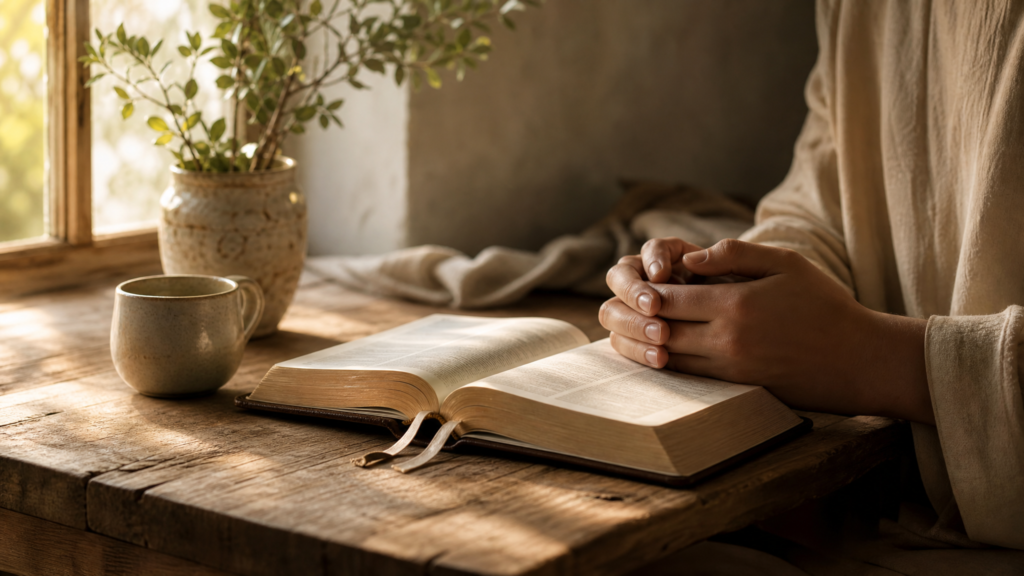
Bible meditation means giving a passage your attention: reading it carefully, reflecting on its meaning, responding in prayer, and considering how to live it. You can begin with five minutes, a Bible, and one short passage. You do not need to complete all seven practices below.
These are suggested ways to structure devotional time, not a list of seven methods that Scripture commands every Christian to follow. Choose the approach that helps you attend to the text today.
| Practice | Suggested time | What you will do |
|---|---|---|
| Slow reading | 5 minutes | Notice what a short passage actually says |
| Verse reflection | 5 minutes | Consider one verse within its surrounding passage |
| Praying a psalm | 5–10 minutes | Use a psalm to begin your own prayer |
| Lectio Divina | 10 minutes | Move through reading, reflection, prayer and rest |
| Scripture journaling | 5–10 minutes | Write an observation, a question and a response |
| Memorization with reflection | 5 minutes | Learn a short verse while considering its meaning |
| A passage-guided walk | 5–10 minutes | Carry one reflection into an ordinary walk |
What makes these practices biblical?
Psalm 1:1–3 connects delight in God’s instruction with sustained reflection. Joshua 1:8 connects meditation with obedience in its address to Joshua. The emphasis is on attending to God’s teaching and living in response; neither passage gives a timer or a seven-part devotional routine. Read the passages in context.
Keep your Bible open as you practice. A phrase that feels meaningful should still be understood within its paragraph or psalm. When something is unclear, note your question and consult a trusted study resource or someone in your church rather than forcing a personal message from it.
1. Read a short passage slowly
Start with Psalm 23. Read it once without stopping, then read it again slowly. Notice who is speaking, who is addressed, and which images recur. Write one sentence beginning, “This passage describes…”
For example, you might notice that the psalm includes both provision and danger. Let that observation guide your reflection instead of treating it as a promise that difficulties will disappear.
Reflection: What did I notice on the second reading that I missed on the first?
Use this method when you want a straightforward place to begin. The task is to pay attention, not to produce an impressive insight.
2. Reflect on one verse in context
Read Philippians 4:4–9, then return to one verse within it. Ask three questions: What is being said? How does it connect with the surrounding sentences? What response might it invite today?
If you choose verse 8, consider its invitation to direct your attention alongside the passage’s teaching about prayer and practice. Write one specific response, such as making room to reflect on something good rather than returning immediately to your phone. Read Philippians 4:4–9.
Reflection: What small action fits what I have read?
This approach gives one verse room to sink in without separating it from the rest of the passage.
3. Turn a psalm into your own prayer
Read Psalm 23, pausing after a sentence that you want to respond to. Speak to God in your own words. You can give thanks, name a concern, ask for help or sit quietly before continuing.
An original prayer might be: “God, help me bring today’s decisions to You. Show me where I need guidance, and help me accept support.” This is a suggested prayer, not a Bible quotation.
Reflection: What can I bring honestly into prayer today?
You do not need to copy the psalm’s emotional tone. If its words feel distant from your experience, that difference can itself become part of your prayer.
4. Try Lectio Divina
Lectio Divina offers a structure for prayerful reading through reading, reflection, prayer and rest. Choose it when you would like a sequence to follow, rather than a single question or a written exercise.
Choose a passage you can read in full within that time. Notice a phrase, consider it in context, and respond to God. A striking thought is something to examine; it is not automatically a direct instruction from God.
Reflection: What would I like to keep considering after this prayer time?
Follow the timed instructions in our step-by-step Lectio Divina guide. That page is the detailed walkthrough; this guide helps you choose between approaches.
5. Keep a Scripture journal
After reading, divide a page into three short sections: “What I noticed,” “What I am asking,” and “My response.” Write a sentence or two in each. Record the passage reference so you can return to it later.
You might record a repeated word, a question you cannot yet answer, and a prayer. Leave space for uncertainty. A journal can hold unfinished reflection; you do not need to turn every entry into a lesson.
Reflection: What question deserves more attention this week?
Use a notebook you already own. A structured journal is optional, and the length or neatness of your entry is not a measure of faith.
6. Memorize a little, then reflect
Choose a short verse from a passage you have read. Read it aloud, cover it, try recalling it, and check the wording in your chosen Bible translation. Learn its reference too. Then explain its meaning in your own words, keeping that explanation separate from the quotation.
Begin with one verse rather than a long list. Return to the surrounding passage on another day so that familiarity with the words does not replace attention to their meaning.
Reflection: Can I explain this verse without changing what it says?
This is a practical learning exercise, not a test you need to pass before praying.
7. Take a passage-guided walk
Before an ordinary walk, read a short passage and choose one question to carry with you. Put the screen away as you move. Let the question return occasionally, and finish by noting one thought or offering a brief prayer. A seated pause works too if walking is not suitable for you.
For example, after a reading you might ask, “What would it mean to respond to this in my next conversation?” Keep attention on your surroundings as you walk.
Reflection: How might today’s reading affect an ordinary part of my day?
The walk is an optional setting for reflection, not a practice the passage itself requires.
A five-minute practice for today
Spend the first minute settling and choosing a short passage. Read for two minutes. Use the next minute to write one observation. Finish with a minute of prayer and one small response you want to remember. If you get interrupted, return when you can.
Prefer words to follow? Our free printable Christian meditation scripts offer longer guided exercises.
Common questions
What if my thoughts wander?
Notice where your attention went and return to the next sentence. You can keep a separate scrap of paper for a task you need to remember. A distracted session does not need to become an abandoned session.
Do I have to feel peaceful afterward?
No particular feeling is required to complete these exercises. Their purpose here is Scripture reflection and prayer. They do not promise relief from anxiety or sleep difficulties.
Should I use all seven methods?
Start with one for a few days. Choose another if a different structure helps you read more attentively. You can also discuss your practice with a trusted person in your church.
Choose your next step
Want a little structure for the coming week? Join the free Seven Days to Biblical Peace challenge. Confirm your subscription to begin the daily emails.
Continue your practice with the Biblical Peace journal
Turn today’s reflection into a regular practice with 21 Days to Biblical Peace, our paid 66-page A4 PDF journal. It brings together Scripture meditations, written prayers, reflection space and a progress tracker to help you organize your devotional time.
One Response